NPS20011 Social Innovation Challenge, Swinburne University of Technology. Team PoleSTARS: Paul Tai, Eric Jose, Tassika Elliot and Matthew Freriks.
My role
I interviewed council representatives about their smart pole programs, and built the poster in Adobe Illustrator, working from design ideas and research contributed by my teammates. I also helped write the final report on implementation: where the poles should go and how they would be built.
The challenge
The City of Boroondara’s Glenferrie Place Plan includes an “Innovation Spine” near Swinburne’s Hawthorn campus. Our team proposed upgrading its street poles into smart poles that add value for the community and local businesses.
The proposal
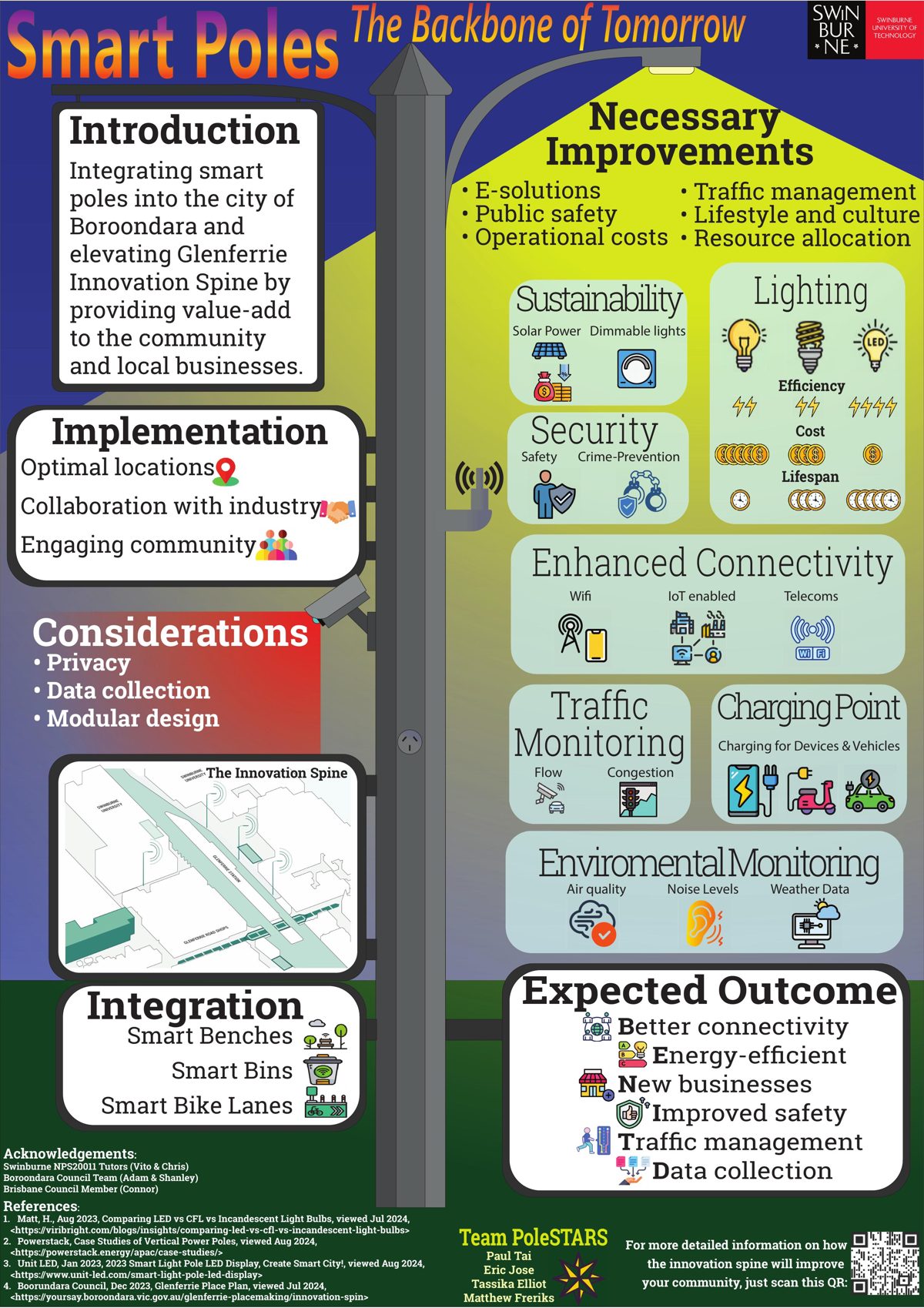
A single modular pole that combines several services:
- Efficient lighting: dimmable LED lights, with solar power where possible.
- Connectivity: public Wi-Fi, telecommunications and Internet of Things connections.
- Safety: cameras and features designed for crime prevention.
- Charging points for devices, scooters and electric vehicles.
- Monitoring: traffic flow and congestion, plus air quality, noise and weather.
We also planned how it would integrate with smart benches, smart bins and bike lanes, where poles should go, and how to involve industry and the community. We treated privacy and data collection as design considerations from the start, not afterthoughts, which matters for anything with cameras and sensors in public spaces.
Working with stakeholders
Our team worked with the City of Boroondara’s council team throughout the project. I interviewed a Brisbane City Council member, about their experience implementing smart poles: the benefits and drawbacks of the data they collect, what they felt they had got right, and where they saw room for improvement. Those conversations shaped what we included, and made our final recommendation more grounded than research alone would have.
Our recommendation
We assessed a specific smart pole vendor in detail, but couldn’t find enough real benefit to justify the cost for the Innovation Spine. Our poster set out what smart poles could offer the community, while our final recommendation was more cautious: wait for the technology to mature, or develop a solution in-house that fits the area’s actual needs. If the council did go ahead, we also set out how the data collected by cameras and sensors would need to be handled to protect people’s privacy.
What I learned
Interviewing a council member taught me how to run a useful interview: come prepared with the questions you need answered, but leave room for the person to go deeper on the parts they know best. Some of the most valuable insights came from those longer explanations rather than my original questions.
I also learned that a good recommendation doesn’t have to be “yes”. Our poster showed what smart poles could offer, but after assessing a specific vendor, we couldn’t see enough real benefit, so we recommended waiting or developing a solution in-house. Separating what a technology could do from whether it’s worth adopting now is a judgement I’ll keep using, especially with new health technologies.