ENG10001 Humanitarian Design and Engineering, Swinburne University of Technology. Engineers Without Borders Challenge 2023, with Andrew Carter, Arthur Baniya, Jacob Fitzgerald and Hamdhan Basry.
The problem
Pu Ngaol is a village of 547 people in Mondulkiri province, Cambodia. It has four water sources, and none of them is both safe and practical:
- The river is easiest to reach but carries silt and bacteria, floods in the wet season and turns turbid in the dry season.
- Groundwater is the most reliable year-round, but contains heavy metals linked to long-term organ damage, and is hard to pump from a water table five metres down.
- Rainwater is the cleanest, but runs out in the dry season.
- Bottled water is safe but a real strain on household budgets.
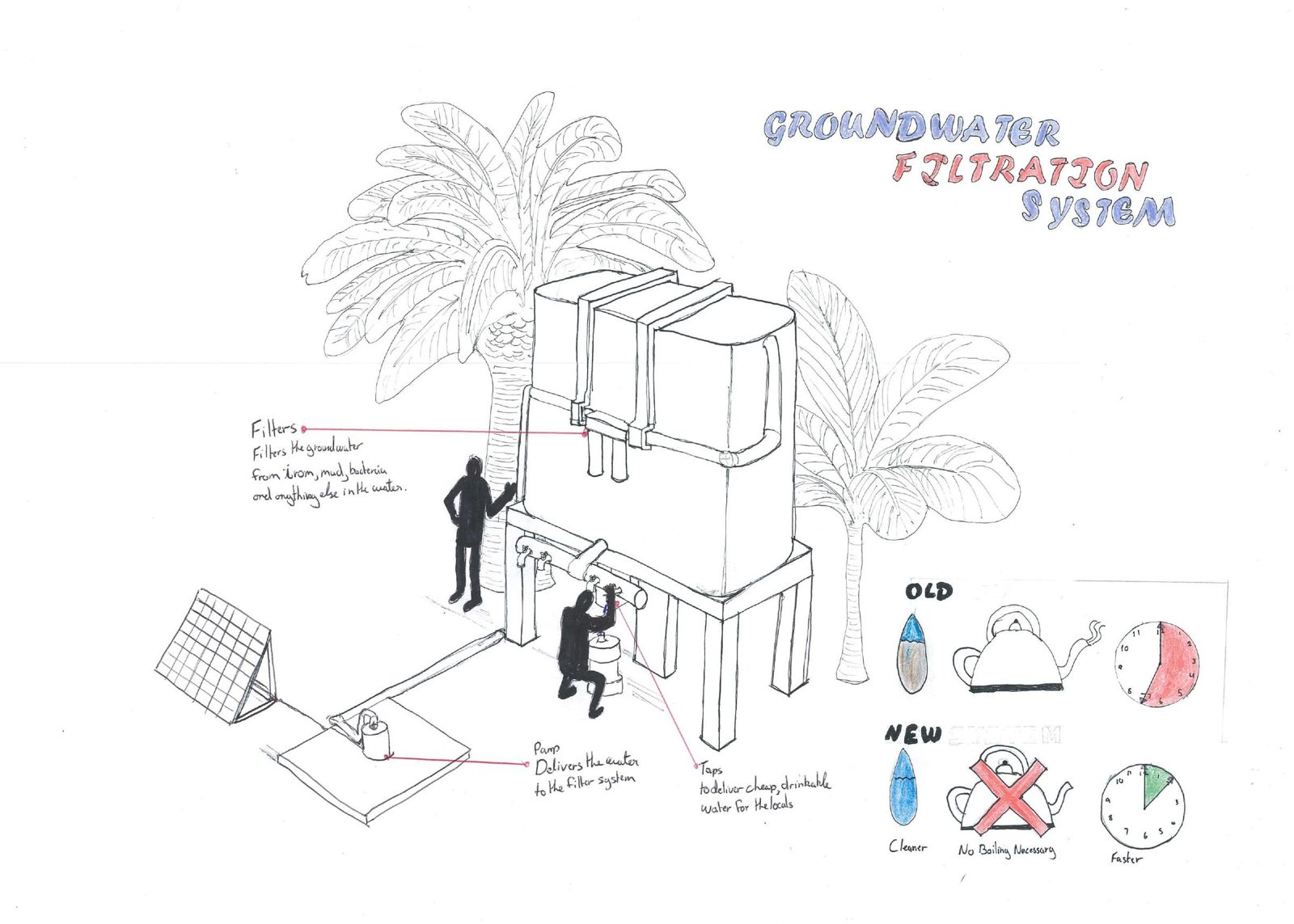
Villagers boiled their water to kill pathogens, but boiling doesn’t remove heavy metals or other chemical contaminants. Collecting drinking water took about four hours every three days, before any time spent boiling it.
Our goal
A consistent, drinkable supply of at least 2,000 litres a day for the whole village, that is affordable to build and run, works through the dry season, withstands harsh weather, and can be maintained by the villagers themselves.
The design
We compared five options: a groundwater system, a river water system, a DIY carbon filter, a rainwater ceramic filter and a small treatment facility. The groundwater system scored best against our criteria, mainly because it’s the only source that’s reliable in every season.
- A solar-powered pump draws groundwater up, so the system needs no mains power or fuel.
- A three-stage filter: a fine mesh for silt, activated carbon, then an ion exchange resin to remove the heavy metals that boiling can’t.
- A 4,000-litre tank on a reinforced concrete slab, raised on five concrete pillars with the taps underneath.
- Four taps, plus a float switch that stops the pump when the tank is full, an overflow valve and a check valve against backflow.
Cost
Materials and labour came to about AUD 1,900, around 1.3% of the village’s combined yearly income, or roughly USD 17 per household. The same amount would buy each household only about a month of bottled water. We proposed that villagers fund the build and maintenance themselves, because people look after what they’ve invested in.
My role
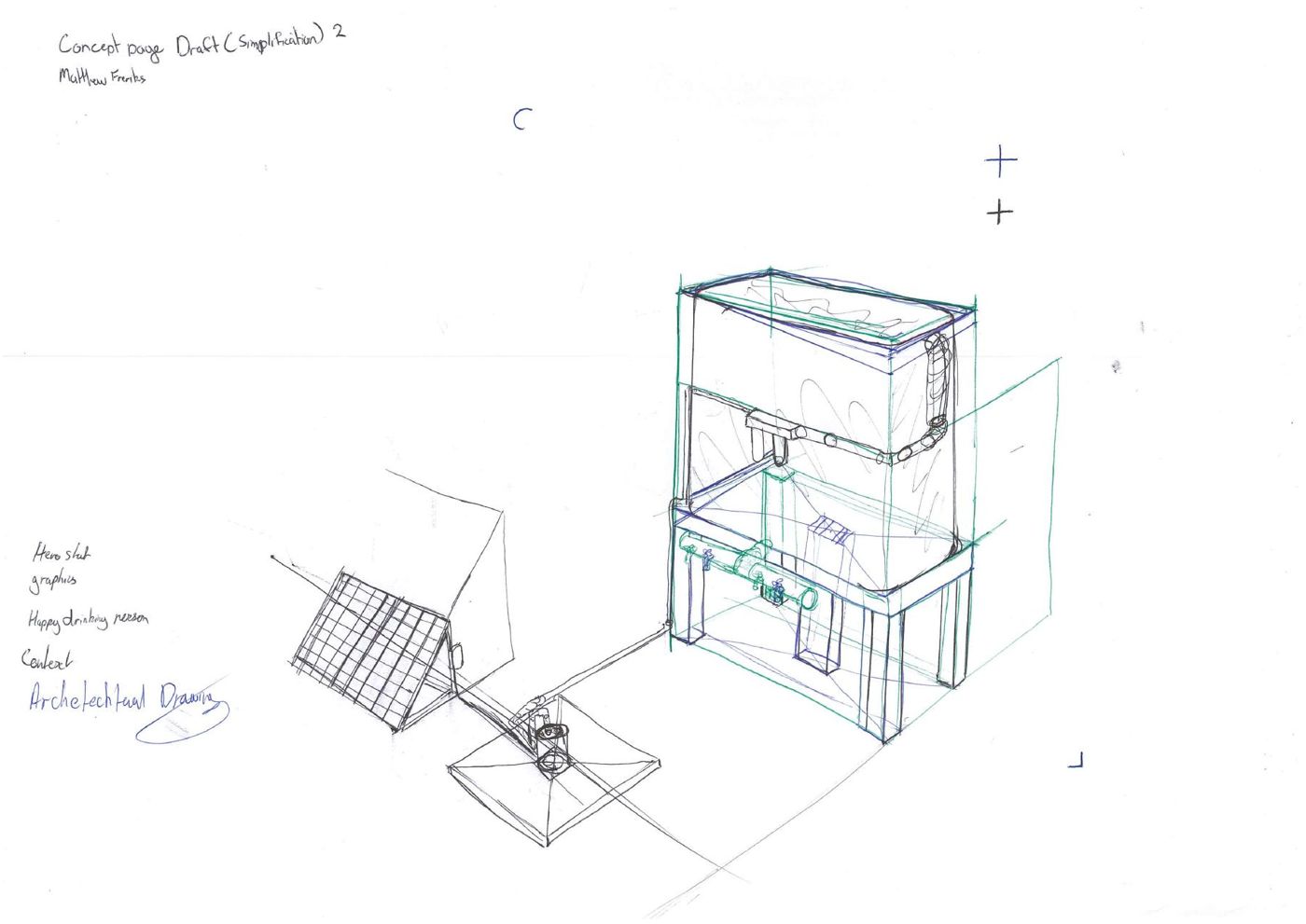
I led the team, delegating sections and keeping everyone on track, and I wrote the largest share of the report: the problem statement and literature review, the design criteria, most of the chosen design including the step-by-step construction instructions, and the community communication and capacity building plan. I also produced the concept drawings by hand, from early sketches to the final illustrated page.
What I learned
Designing for a community thousands of kilometres away meant learning to understand people’s needs without being able to ask them directly, mostly through careful reading of research. It was also my first experience leading a team: delegating work, keeping people motivated when they hit a rut, and covering for teammates when other commitments got in the way.